Zen and the Art of Design System Maintenance
My reflections on working with design systems.
3 min read
While building a design system, I kept coming back to a book I was reading at the time: “Zen and the Art of Motorcycle Maintenance”. The plot revolves around road trips and motorcycle repair, but the core ideas of the book are in the philosophical reflections of the narrator. Motorcycle maintenance as a (presumed) metaphor of a classical, rational and analytical mode of thinking mirrored the struggles I faced when creating and maintaining the design system.
Challenge 1
Losing the Forest for the Trees
Pirsig observes that humans instinctively divide the world into categories to make sense of it. That’s how science, logic, and much of Western philosophy works: breaking things down, labelling the parts, and arranging them in order. “The application of this knife, the division of the world into parts… is something everybody does.”
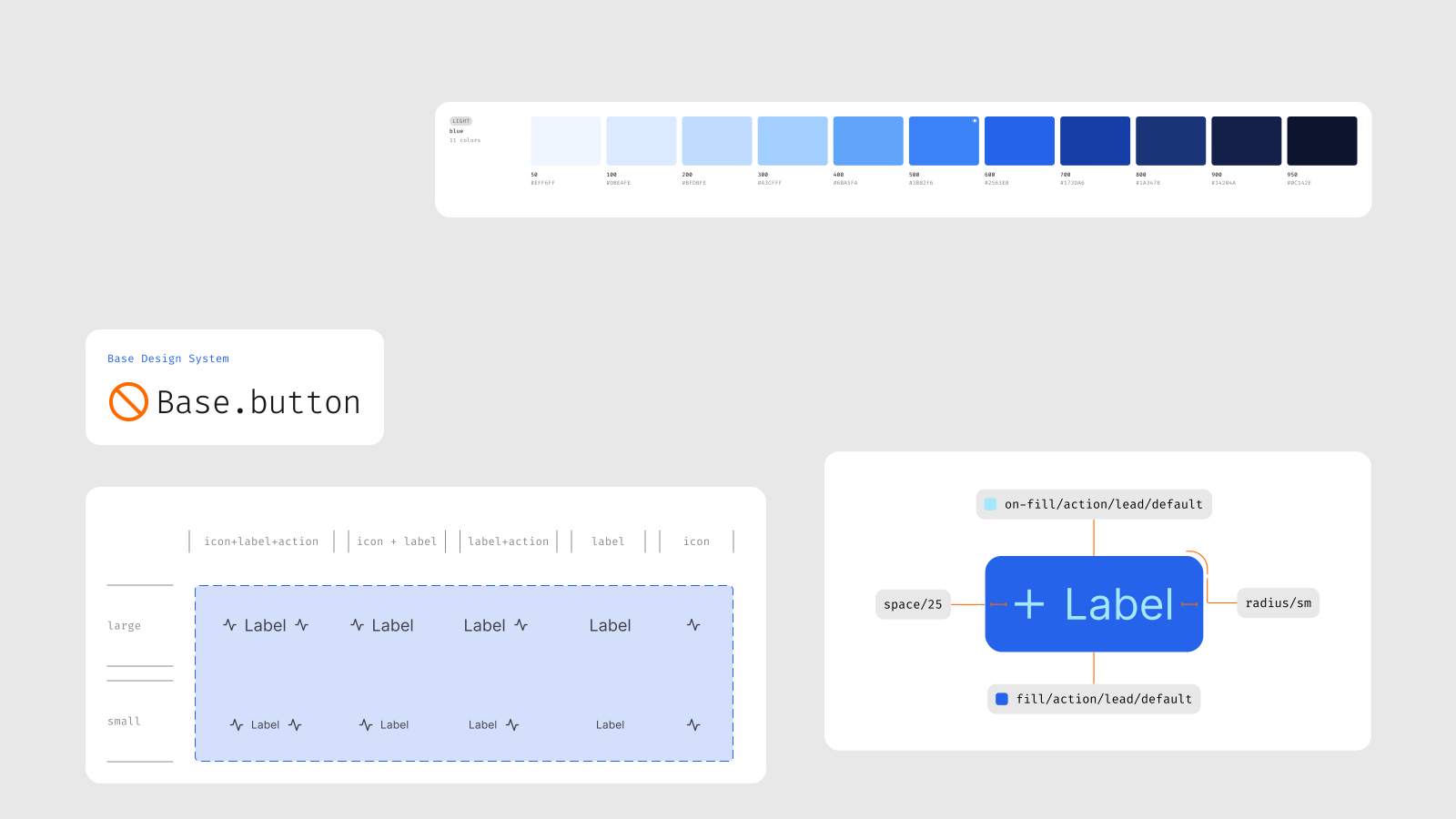
In design systems, the “knife” is our categorisation: properties, tokens, variants, roles. I spent a lot of time creating a taxonomy of semantic color tokens, e.g. trying to decide whether my semantic color groups and therefore namings should be defined first by the design element where they are expected to appear (e.g., borders, fills, foregrounds, etc) or whether they are static or interactive (is this a color for a static page background or for an interactive button’s fill that should also have states like “hover” or “pressed”).
At some point, classification became the main task. I created a taxonomy that (in my head) worked perfectly well, but when other people started to apply it in their designs, it quickly became too rigid and not suitable for their specific context. For example, how does one chooses the color token classified as “on-bg” (on-background) vs “fg” (foreground) when we always have some kind of a background color beneath. And even when the logic of categorisation and naming did make sense (suprise, it actually happenned!), it could still produce the desing flow with components that looked odd when placed next to one another.
This is when I came across Pirsig’s quote: “When analytic thought, the knife, is applied to experience, something is always killed in the process.”
That “something” became the forest as a metaphor of the whole: the actual user experience, the product’s quality, or even the team’s shared understanding.
Challenge 2
The Trap of Over-Categorisation in our Roles
Another kind of categorization shows up in how we split ourselves in the team: designer vs. developer, handoff vs. implementation. This maps to how Pirsig reflects on the “mechanic vs. artist” in the book, framing this split as classical vs. romantic modes of thinking. Pirsig argues the two perspectives actually belong together, and I noticed that being true when the lines between developer’s and designer’s influence on the design system became blurry. Operational perspective (e.g., developers care about performance issues, edge cases, accessibility) and experiential perspective (e.g., designers care about flow, hierarchy, rhythm) are both equally important, and the system thrives when both perspectives are maintained together.
Challenge 3
Changing the Mindset from “Serving Prison Time” to “Gardening”
A design system is never finished, it evolves alongside the product and the people who maintain it. When working with a design system in a different project, our team of designers rotated responsibility: each week a different designer was responsible for adding / editing components, documentation and communication with developers. At first we joked that whoever was responsible that week was “serving prison time.”
But over time, the metaphor shifted to treating it like a gardening work. It resonated a lot with Pirsig’s view on repetitive, detailed and tedious work of motorcycle maintenance:
“…a kind of inner peace of mind… a harmony with the work in which there’s no leader and no follower. The material and the craftsman’s thoughts change together… until his mind is at rest at the exact instant the material is right.”
Seeing this work as meditative practice also helped me change my perspective, not expect this work to be ever finished, and to start treating it more like a Zen garden work.
Still Work in Progress
I’m still working on this design system, and the ideas from the book show up very often. Sometimes I get lost in categorisation and have to pull myself back to look at the flow. Other times I’ll try a component in a real context first, then bring it back to the system to refine its structure.
I’ve also learned to bring the team in earlier, especially on something as simple as naming. It saves hours of debate if everyone reacts quickly instead of after I’ve polished a taxonomy.
This work is not about reaching a perfect end result, but more about moving back and forth between analysis (the classic mode) and experience (the romantic mode), just as Pirsig prescribed. 🤷♀️
Like What You See? See More in Work & Blog.
Contacts
v.dzhekanovich@gmail.com